
Last updated September 10, 2026
Full 25-point door and opener safety check with every visit - springs, cables, rollers, tracks, and your LiftMaster or Chamberlain opener included
You get a price before we start. It does not change when the truck arrives.
 Before
 After
After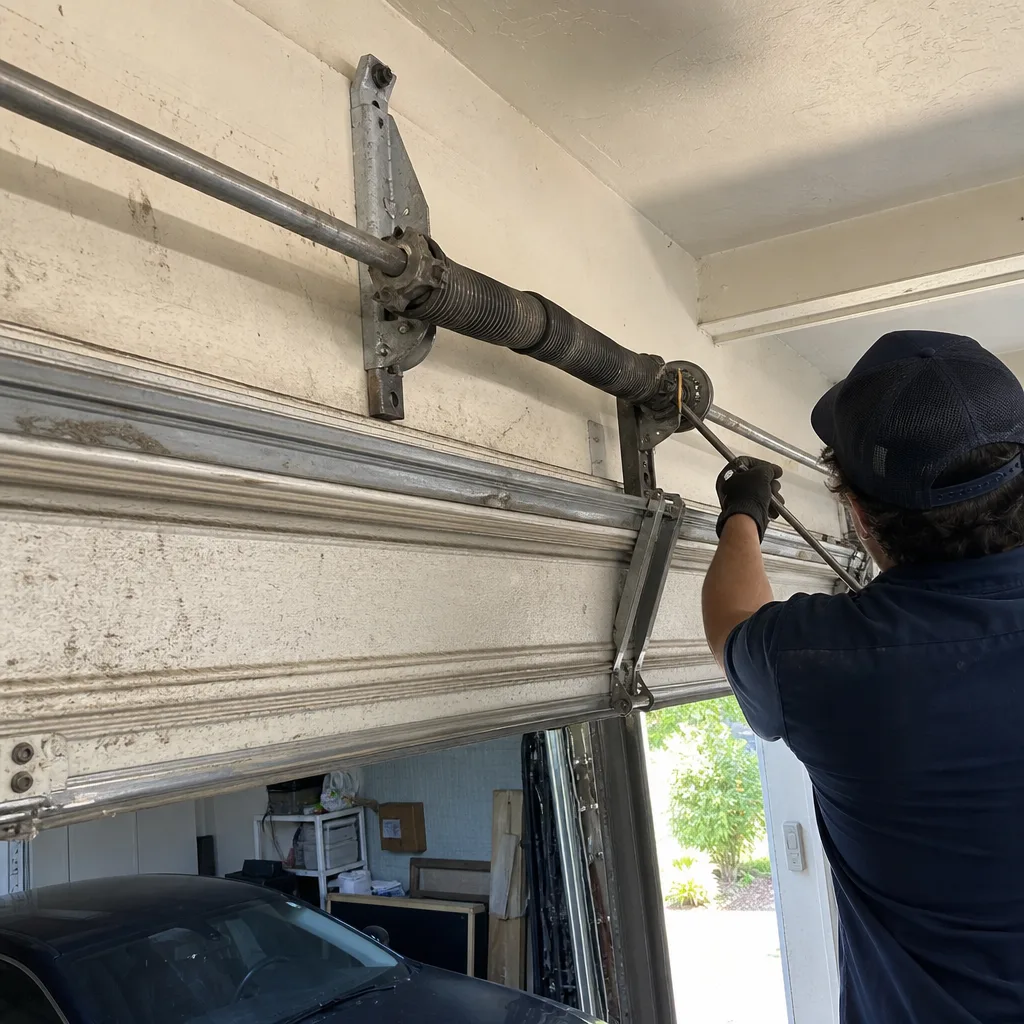 Before
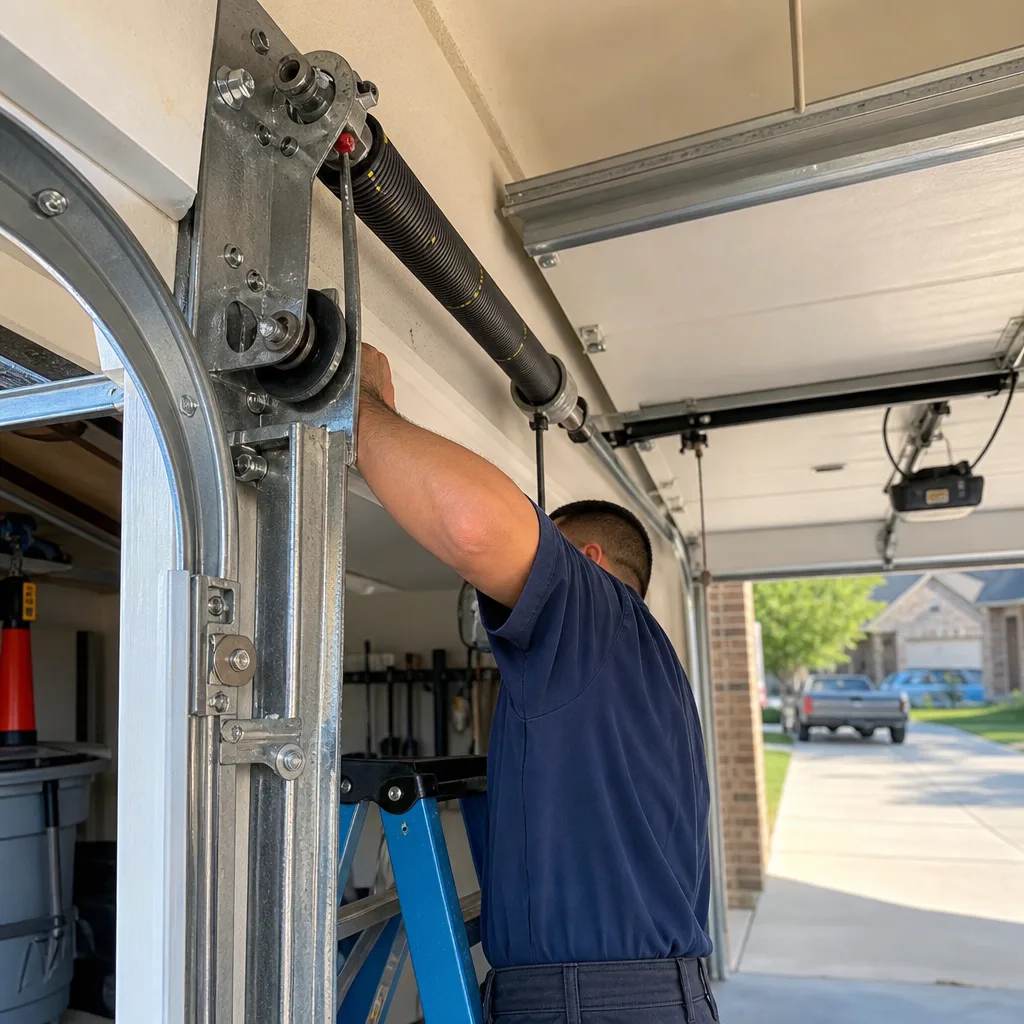 After
After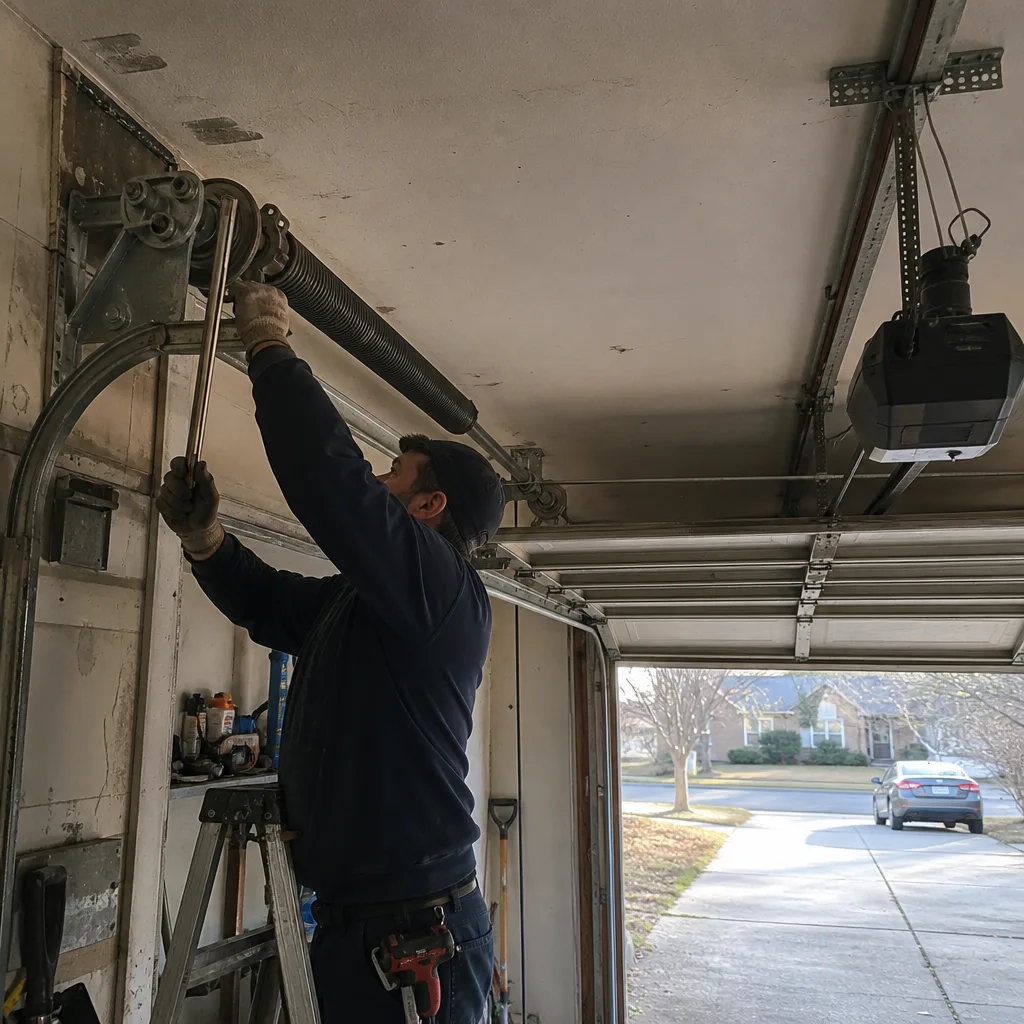 Before
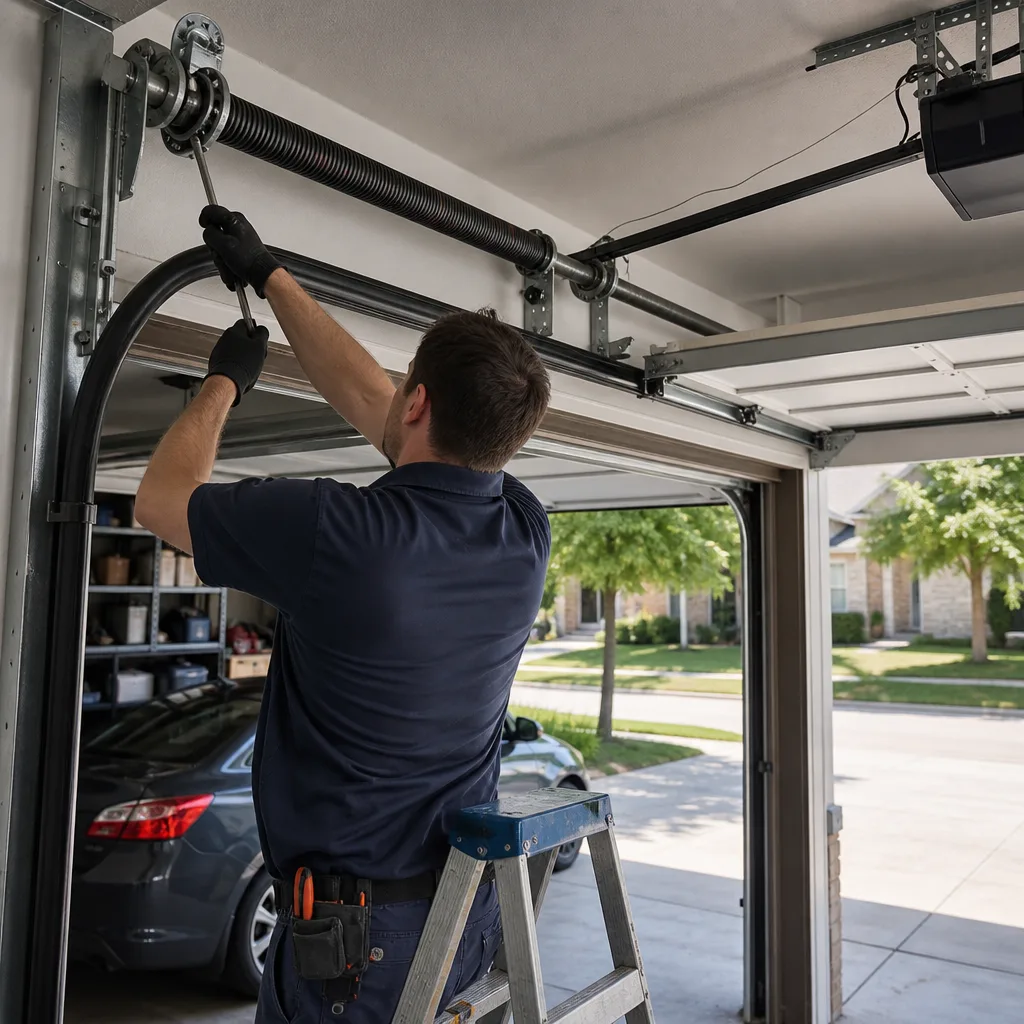 After
AfterGarage Door Warning Signs: A Frisco Homeowner’s Reference Guide
A garage door that hesitates for two seconds before moving is not “a little slow.” It is a spring that has lost enough tension to make the opener work outside its design load, and the motor is the next thing to fail. In Frisco, where summer heat pushes metal fatigue faster than in cooler climates, we see this progression constantly: the hesitation ignored, the opener burned out, and a $180 spring repair becomes a $680 spring-plus-opener job. Every failure that costs Frisco homeowners over $500 was preceded by at least two observable warning signs that got ignored. This guide names those signs precisely, explains the mechanical reason each one matters, and tells you which ones mean “schedule service this week” versus “do not operate the door until a tech arrives.” For more guides & resources, see our blog.
Quick Answer
The most critical garage door warning signs are: hesitation on start-up (failing spring), loud popping or grinding noises (spring or opener gear failure), uneven travel or sagging (cable or spring imbalance), and reversal without obstruction (misaligned safety sensors or track issue). In Frisco’s heat and clay-soil conditions, these signs progress faster than in milder climates, making Seasonal Garage Door Care for Frisco: Year-Round Homeowner’s Guide essential reading. A door showing any of these symptoms needs professional inspection within days; a door with a visible frayed cable or broken spring should not be operated at all.
Table of Contents
- Sound-Based Diagnostics: What Each Noise Means
- Visual Tells: Reading Wear Without Getting Near Moving Parts
- Operational Warnings: Hesitation, Uneven Travel, and Reversal
- The One Warning Sign Most Homeowners Mistake for a Remote Battery Issue
- Frisco-Specific Factors: Heat, Soil, and Storm Season
- Schedule Service This Week Versus Do Not Operate
- Common Mistakes to Avoid
- When to Call a Professional
- Frequently Asked Questions
- The Bottom Line
Sound-Based Diagnostics: What Each Noise Means
Your garage door is a mechanical system with exactly one quiet state. Every new sound is a signal, and the specific character of that sound points to a specific component under stress. Learning to distinguish these three noises will save you from the most expensive repairs we see in Frisco.
The Grinding Noise
Grinding is the sound of metal sliding against metal without adequate lubrication, or of gear teeth stripping inside the opener. It is a low, continuous rumble, often accompanied by vibration you can feel through the wall.
In Frisco’s summer heat, garage temperatures regularly exceed 110°F. At those temperatures, standard lithium grease thins and migrates away from roller bearings and opener gearboxes. The grinding you hear is often the opener’s main drive gear, a nylon or plastic component, being eaten away by the metal worm gear above it. Once that drive gear loses teeth, the opener cannot be repaired economically. Replacement is the only option.
Grinding from the door itself, rather than the opener, usually indicates dry or failing rollers. Steel rollers without ball bearings grind against their shafts. Nylon rollers grind when their bearings seize. Either way, the roller is no longer rolling; it is dragging, which puts lateral force on the track and accelerates wear on every connected component.
What to check: Stand inside the garage with the door closed. Have someone activate the opener. If the grinding starts before the door moves, the source is the opener. If it starts as the door begins to travel, the source is the door hardware.
The Popping Noise
Popping is a sharp, percussive sound, like a firecracker or a cracking knuckle. It is the sound of a torsion spring releasing stored energy in an uncontrolled snap, or of a roller binding in the track and then breaking free.
Torsion springs are calibrated to a specific number of cycles, typically 10,000 for standard springs. Each open-close pair is one cycle. A family using the door four times daily cycles through that lifespan in about seven years. In Frisco, where many homes in neighborhoods like Stonebriar and The Trails were built during the 2000s boom, we are now seeing mass spring failures as original springs reach end-of-life simultaneously.
A single pop during door travel often means a spring has broken internally but the coils are still held in partial tension by friction. The door may still operate, but it is running on borrowed time. Multiple pops, or a pop followed by a loud bang, means a complete spring failure. The door is now dead weight, and the opener is trying to lift it alone.
Critical safety note: Torsion springs store lethal energy. A standard 16-foot residential door spring holds roughly 200 foot-pounds of torque. Never attempt to adjust, repair, or replace a torsion spring. The winding bars required for safe service are specialized tools, and the technique takes years to master. We have seen serious injuries from homeowners who watched online videos and attempted this themselves.
The Scraping Noise
Scraping is a sustained, metallic drag, lower in pitch than grinding. It means something is contacting something it should not.
The most common source is a door that has shifted on its track, causing the edge of a roller bracket or hinge to scrape the track wall. This happens when cables stretch unevenly, when a spring begins to fail on one side, or when the vertical track has been knocked out of plumb by vehicle contact.
In Frisco’s expansive clay soils, garage slabs shift seasonally. We see this especially in newer developments like Phillips Creek Ranch and older areas like Preston Vineyards, where soil movement has put vertical tracks out of alignment. The scraping is your early warning that the door is traveling a path it was not designed for, and every cycle is bending the track slightly more.
What to check: With the door closed, inspect the gap between the door edge and the track on both sides. It should be even from top to bottom. If one side shows metal-to-metal contact marks, or if the gap narrows at any point, the track needs realignment before the door binds completely.
Visual Tells: Reading Wear Without Getting Near Moving Parts
You do not need to touch a garage door to diagnose most problems. These four visual inspections take sixty seconds and require no tools. Perform them monthly, and more often during Frisco’s storm season when wind load and debris impact accelerate wear.
Cable Fraying
Lift cables run from the bottom corners of the door to the cable drums at the spring shaft. They are aircraft-grade steel, but they flex through a sharp bend at the bottom bracket every cycle, and they abrade against drum edges if tension is uneven.
Look for these specific indicators:
- Birdcaging: Individual strands have broken and flared outward, creating a fuzzy or bristled section. This means the cable has lost significant strength and will fail unpredictably.
- Flat spots: A section of cable appears compressed or deformed where it has been kinking against a drum or pulley. The internal structure is compromised even if no strands are visibly broken.
- Rust staining: Orange-brown discoloration at the bottom bracket or drum indicates moisture intrusion, usually from condensation in uninsulated garages. Rust reduces cable strength by 30-50% before visible breakage occurs.
A frayed cable is not a maintenance item for next quarter. It is a failure in progress. When a cable snaps under load, the door drops on the remaining cable side, jams in the track, and often bends the door sections. We have responded to emergency calls in Frisco’s Frisco Square and Main Street District areas where a cable failure on a Saturday morning trapped a vehicle inside the garage hours before a family departure.
Roller Wear
Rollers are the small wheels that carry the door in the track. There are three types in common use, and each fails differently:
- Steel rollers with exposed ball bearings: Look for grease that has turned black and gritty, or bearings that wobble visibly when the door moves. These rollers are durable but noisy, and neglected lubrication leads to seized bearings that drag and grind.
- Nylon rollers with sealed bearings: The nylon tire should be intact, not cracked or flattened. These are quieter but less durable; a cracked nylon tire can split and jam in the track.
- Steel rollers without bearings (builder-grade): These are solid steel rods in a steel housing. They grind from day one and are the cheapest component a builder can specify. If your Frisco home was built in the 1990s-2000s with original hardware, you likely have these. The tell is a persistent metallic squeal that lubrication only temporarily quiets.
Rollers should be replaced in complete sets. Mixing new and worn rollers creates uneven travel that stresses the door sections.
Hinge Cracks
Steel hinges connect the door sections and contain the roller stems. They are stamped from galvanized steel and fatigue at the bend radius where the two leaves meet.
Inspect hinges with the door closed. Look for:
- Hairline cracks radiating from the pin hole or the bend line
- White or gray stress marks in the galvanizing, indicating metal fatigue beneath
- Hinges that have been bent by impact and never properly straightened
A cracked hinge is not a slow failure. When it lets go, the door section separates, the roller drops out of the track, and the door jams catastrophically. In a windstorm, a door with cracked hinges can fold and detach from the track entirely. Frisco’s position on the southern edge of Tornado Alley makes this a genuine risk during spring storm season.
Spring Gaps
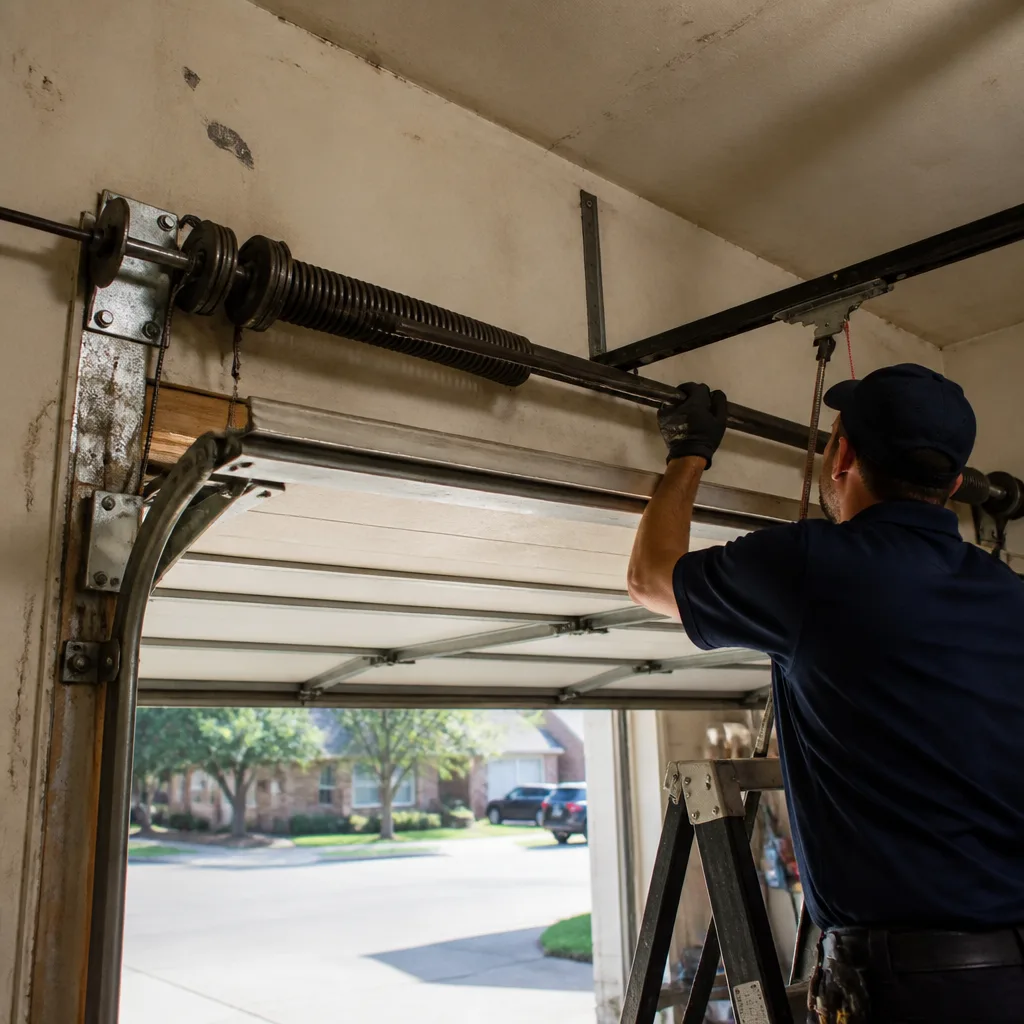
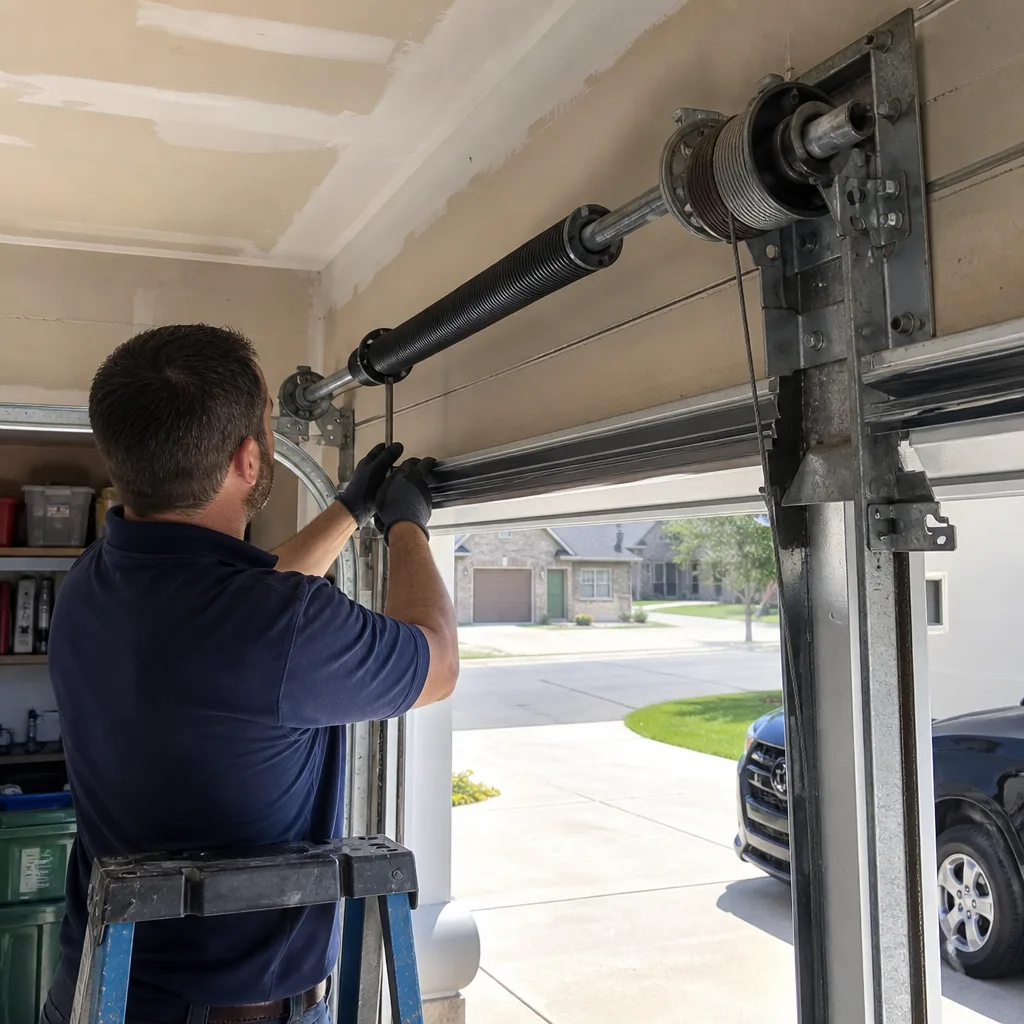
Torsion springs are wound tightly when the door is closed. Examine the spring from the side, standing clear of the door’s path. A healthy spring shows coils pressed tightly together with no visible gaps. A spring that has lost tension shows a visible gap between coils, typically 1/4 to 1/2 inch, where the spring has relaxed and cannot return to full tension.
This gap means the spring has broken internally. It may still assist the opener, but it is carrying less than its share of the door’s weight. The opener compensates, working harder and failing sooner. The remaining spring, if there are two, is now overloaded and will fail prematurely as well.
Operational Warnings: Hesitation, Uneven Travel, and Reversal
How the door moves is as diagnostic as how it sounds. These three operational symptoms predict specific failure modes with high reliability.
Hesitation on Start-Up
A properly balanced door begins moving within one second of opener activation. If your door sits still for two seconds or more, then jerks into motion, the opener is straining against excess weight.
The mechanical explanation is straightforward. A garage door weighing 150-200 pounds is counterbalanced by torsion springs calibrated to that exact weight. When springs weaken, the door’s effective weight increases. The opener, designed to move a balanced door with 1/2 to 3/4 horsepower, must now lift 50, 75, or 100 excess pounds. The motor draws excess amperage, overheats, and degrades its internal components.
We see this constantly in Frisco’s older neighborhoods like Grayhawk and Heritage Lakes, where original springs are failing after 15-20 years. The homeowner notices the hesitation, assumes the opener is “getting old,” and replaces the opener without reading How to Hire a Garage Door Contractor in Frisco: A Step-by-Step Guide. Six months later, the new opener shows the same hesitation because the root cause, the springs, was never addressed. The correct sequence is always: balance the door first, then assess whether the opener needs replacement.
Simple test: Disconnect the opener by pulling the red release cord. Lift the door manually to waist height. A balanced door stays put. A heavy door drops, and a light door rises. If the door feels heavy or drops, the springs need service before the opener does.
Uneven Travel
The door should rise and lower in a level plane, with both sides moving at identical speed. If one side leads by even a few inches, the door is racking, or twisting in its frame.
Uneven travel has three common causes:
- Single spring failure on a dual-spring door: One spring is doing all the work. The door rises at an angle, putting enormous stress on the track, rollers, and door sections.
- Uneven cable tension: One cable has stretched or slipped on its drum. The low-tension side lags, and the door skews.
- Track misalignment: One vertical track is not plumb, forcing that side of the door to travel a longer path.
Racking is progressive and destructive. Each skewed cycle bends the door sections slightly, deforms the track, and enlarges the misalignment. We have replaced entire door systems in Frisco’s newer construction where racking was ignored for months, until the door sections were too twisted to realign.
Reversal Without Obstruction
Since 1993, federal law has required garage door openers to reverse direction if they encounter obstruction. Modern openers use two methods: mechanical force sensing, which measures motor current increase, and photoelectric eyes, which detect interruption of an infrared beam across the door opening.
If your door begins to close, then reverses without anything blocking it, the cause is usually one of these:
- Misaligned safety sensors: The photoelectric eyes have been bumped and no longer face each other directly. A green or amber LED on one sensor indicates alignment; no light or a blinking light indicates misalignment. In Frisco, where foundation settling is common in clay soil, we see garage floors shift enough to knock sensors out of alignment without any direct contact.
- Sunlight interference: Direct afternoon sun into a west-facing garage can blind the receiver sensor. This is particularly common in Frisco’s open-plan neighborhoods with minimal tree cover, like Panther Creek and Villages of Stonelake. The symptom is reversal only during specific hours, typically 4-7 PM in summer.
- Force setting too sensitive: The opener’s internal force limit has been adjusted down, or the door has become heavy enough that normal travel triggers the safety reverse. This last cause is critical: it means the door is out of balance, and the safety system is correctly refusing to close an unsafe door.
Never override the safety reverse by adjusting force settings upward. If the door reverses without obstruction, diagnose why. The safety system is working; the door is not.
The One Warning Sign Most Homeowners Mistake for a Remote Battery Issue
The door responds to the wall button but not the remote, or the remote works only from very close range. The immediate assumption is dead batteries. Often, it is not.
Modern garage door openers use rolling-code encryption for security. The remote and opener synchronize through a radio frequency signal, typically 315 or 390 MHz. When the opener’s logic board begins to fail, its radio receiver sensitivity degrades before any other function shows symptoms. The wall button, hardwired directly to the opener, continues to work perfectly. The remote, which depends on radio reception, works only when very close or not at all.
The homeowner replaces batteries, maybe replaces the remote, and the problem persists or returns within weeks. The root cause is a failing logic board, usually from electrical surge damage or age-related capacitor degradation.
Frisco’s electrical grid, like much of North Texas, experiences frequent brief outages and voltage fluctuations during storm season. These surges damage opener electronics without any visible sign. A whole-house surge protector is the best prevention, but most homes lack one.
How to distinguish remote failure from logic board failure:
- Test the remote battery with a multimeter or by using the remote very close to the opener. If it works at 3 feet but not at 30 feet, the battery is not the issue.
- Check whether the issue affects all remotes and the wireless keypad equally. Multiple devices failing simultaneously points to the receiver, not the devices.
- Listen to the opener when the remote is pressed from distance. If you hear a faint relay click but no motor activation, the receiver is picking up the signal but the logic board is not processing it correctly.
Logic board replacement is often not cost-effective on older openers. A new LiftMaster or Chamberlain opener with modern encryption, battery backup, and smartphone connectivity typically outlasts a repaired legacy unit.
Frisco-Specific Factors: Heat, Soil, and Storm Season
Garage doors in Frisco fail differently than doors in Minneapolis or Seattle, as detailed in The Complete Guide to Garage Door in Frisco. Three local factors accelerate specific wear patterns.
Thermal Cycling and Metal Fatigue
Frisco’s summer garage temperatures, measured in attached garages with western exposure, routinely reach 115-125°F. Winter overnight lows can drop below 20°F. That 100-degree annual temperature swing causes repeated expansion and contraction in metal components.
Torsion springs are particularly vulnerable. Each thermal cycle stresses the spring steel at the molecular level. Over years, this accumulates as microcracks that propagate to failure. A spring rated for 10,000 cycles in moderate climate may achieve only 7,000-8,000 cycles in Frisco’s thermal environment. We account for this in our spring selection, specifying higher-cycle springs for Frisco installations when homeowners plan long-term residency.
Expansive Clay Soil
Frisco sits on the Blackland Prairie, with high-shrink-swell clay soils that move dramatically with moisture changes. A wet spring followed by a dry summer can lift or drop a garage slab by an inch or more.
This movement affects garage doors in two ways. First, the vertical tracks, anchored to the garage frame, shift relative to the door opening, causing binding and racking. Second, the header above the door, which carries the spring and opener mounting, cracks or separates from the frame, loosening the entire assembly.
In neighborhoods like Newman Village and later phases of The Trails, where homes were built during the 2010-2015 construction rush, we are now seeing the cumulative effect of ten years of soil movement. Annual track realignment and header inspection should be standard maintenance, not emergency repairs.
Wind and Debris Load
Frisco’s position at the intersection of Tornado Alley and severe thunderstorm country means doors face wind loads that exceed their design ratings several times yearly. A standard 9×7 residential door is rated for 20 psf wind load. A severe thunderstorm downdraft can apply 30-40 psf briefly.
The warning sign is subtle: after a storm, the door operates but feels different. It may be slightly harder to lift manually, or the opener may sound strained. This often means the door has been racked or the track bent by wind pressure, and the system is now operating out of specification. Post-storm inspection is prudent, not paranoid.
We also see debris impact damage after hail and wind events. A section dent from a tree limb may seem cosmetic, but any dent deep enough to deform the internal reinforcement strut has weakened the door’s structural integrity. That section is now a failure point in the next wind load event.
Schedule Service This Week Versus Do Not Operate
Not every warning sign demands immediate emergency response, but some do. This decision matrix is based on what we have learned from thousands of Frisco service calls over four decades.
Schedule Service Within the Week
- Grinding noise from rollers or opener: Annoying and destructive, but the door is safe to operate for limited use. Avoid repeated cycles until serviced.
- Slight hesitation on start-up: The springs are weakening but functional. Schedule before the opener is damaged.
- Minor roller wobble or hinge corrosion: Wear is present but not critical. Plan replacement at next convenient appointment.
- Remote range intermittently reduced: Likely logic board degradation. The door is safe; convenience is affected.
- Sensor misalignment with no other symptoms: The safety system is falsely triggering. The door can be operated manually or with the wall button while holding the button continuously.
Do Not Operate - Call for Emergency Service
- Visible gap in torsion spring: The spring has failed. The door is unbalanced and dangerous to operate. The opener may lift it partially, then drop it unpredictably.
- Frayed or birdcaged lift cable: Imminent failure with risk of sudden door drop. Do not use the door.
- Cracked or separated hinge: The door section connection is compromised. Operation risks catastrophic jam or section separation.
- Door racking severely during travel: One side is rising 6+ inches ahead of the other. Continued operation will destroy the door and track.
- Loud bang followed by door that will not lift: Complete spring failure. The door is dead weight. Do not attempt manual lift; it requires 150-200 pounds of force and risks back injury or door damage.
- Door that reverses repeatedly and force adjustment does not help: The safety system is detecting a genuine problem. Forcing closure risks entrapment or damage.
When in doubt, err toward not operating. A service call is cheaper than an emergency repair or injury. Garage Door Repair in Frisco from Mainspring includes free estimates, and our trucks carry the parts to complete most jobs in a single visit.
Common Mistakes to Avoid
- Ignoring the first hesitation: That two-second delay is not “getting old.” It is a spring failing and an opener being destroyed. We replace dozens of prematurely failed openers in Frisco each year because the root cause was ignored.
- WD-40 on rollers or springs: WD-40 is a solvent and light penetrant, not a lubricant. It strips existing grease and attracts dust. Use lithium-based grease on metal components, silicone spray on vinyl or rubber parts.
- Replacing the opener before checking door balance: This is the most expensive mistake we correct. A new opener on an unbalanced door fails the same way the old one did. Always balance first.
- Adjusting force settings to override safety reverse: This defeats a federally mandated safety system and risks crushing injury. If the door reverses, find the obstruction or misalignment. Never increase force to compensate for a mechanical problem.
- DIY spring replacement after watching online videos: The videos rarely show the injuries. Torsion spring winding requires specialized bars, training, and respect for the stored energy. We have seen fractured wrists, facial lacerations, and worse from attempted DIY.
- Waiting for “both springs to fail” before calling: If one spring on a dual-spring door has failed, the other is carrying double load and will fail soon, often catastrophically. Replace in pairs.
- Assuming a dented door section is only cosmetic: In Frisco’s wind exposure, a weakened section is the failure point in the next storm. Structural integrity matters for wind load rating.
When to Call a Professional
Call when you observe any warning sign described in this guide and are uncertain of its severity. Call immediately if the door shows visible damage to springs, cables, or hinges, or if it operates in a way that feels unsafe. Call if the door has been exposed to severe weather and now operates differently.
We have served Frisco homeowners since 2016, and Mainspring Garage Door Co. has been a Texas trade shop since 1984. Our technicians arrive in uniform, background-checked, with springs, cables, rollers, and openers on the truck. We state the flat price before any work begins, and every job is covered by our 90-Day Done Right Promise in writing. If it is not right, we come back. No paperwork, no argument.
Mainspring Garage Door Co. offers free estimates in Frisco. Call (945) 495-3756 to speak with a live person, any hour. We answer our own phones. No phone trees, no voicemail, no after-hours service.
Frequently Asked Questions
Standard torsion spring replacement in Frisco typically runs $180-$340 for a single spring, $320-$480 for a dual-spring system, depending on door size and spring cycle rating. We quote the exact price before any work begins, and our $50 off any repair over $250 applies to dual-spring jobs. Call (945) 495-3756 for a free estimate.
You should not. A broken spring means the door weighs its full 150-200 pounds. The opener may struggle to lift it, then drop it unpredictably. Manual lifting risks serious back injury and door damage. If you are trapped inside, call for emergency service rather than forcing the door.
Annually, and after any severe storm. Frisco’s thermal cycling and soil movement accelerate wear beyond what annual inspection addresses in milder climates. Our $89 Seasonal Tune-Up includes balance check, hardware inspection, lubrication, and safety system test.
If new batteries do not solve it, the cause is usually a failing logic board radio receiver, not the remote itself. This is common after electrical storms in Frisco. We can diagnose whether repair or opener replacement is the better value.
No. We state the flat price before any work begins. If we discover additional issues during inspection, we explain them and quote separately. You approve every dollar before we proceed. No surprises on the bill.
Yes. Our trucks are stocked with torsion springs, extension springs, lift cables, rollers, hinges, and openers from LiftMaster, Chamberlain, Genie, and other major brands. Most Frisco repairs are completed in a single visit. We do not return for parts.
The Bottom Line
Every garage door failure that costs Frisco homeowners over $500 announces itself beforehand. The hesitation, the pop, the frayed cable, the grinding at 6 AM - these are not quirks to tolerate. They are mechanical distress signals with specific causes and predictable consequences. Learning to read them takes ten minutes. Acting on them saves hundreds of dollars and prevents the inconvenience of a door that fails when you are already late.
The door that fails completely was the door that hesitated last month, popped last week, and finally gave up this morning. The homeowners who call us early get a spring replaced for a flat price and a door that runs quiet for years. The homeowners who wait get emergency service, possible opener damage, and a Saturday morning they did not plan to spend in the garage.
We have been in this trade long enough to know that no one wants to think about their garage door. That is the point of doing it right: so you never have to think about it again. Mainspring Garage Door Co. home | Garage Door Installation in Frisco | Garage Door Opener in Frisco
Written by Carl Dutton, Owner at Mainspring Garage Door Co., serving Frisco since 2016.